Introduction
Choosing the best programming language to learn can be confusing, especially when you are just getting started with coding. There are hundreds of languages out there, and each one is built for different types of work. Some are better for websites, while others are widely used for AI, mobile apps, games, or software development.
The good news is that you do not need to learn every programming language. What matters is choosing one that matches your goals and gives you useful skills for the future. Python, JavaScript, Java, C++, and several other languages remain popular choices for different areas of technology.
In this guide, we’ll look at nine of the best programming languages to learn in 2026. We’ll explain what each language is used for, why you might want to learn it, and which type of learner or career it suits best.
What Is a Programming Language?
A programming language is a way for people to give instructions to computers. Instead of using everyday language, developers write instructions using specific words, symbols, and rules that a computer can process.
Programming languages are used to create almost every type of digital product we use today. Websites, mobile apps, games, desktop software, and many online services all depend on code.
Each programming language has its own strengths. Python is known for its simple syntax and wide range of uses, while JavaScript is closely connected to web development. Other languages are designed for specific areas, such as mobile development, databases, or high-performance software.
You do not need to understand every programming language to become a programmer. Learning one language properly can give you the foundation you need to understand others later.
How Should You Choose a Programming Language?
Choosing the best programming language to learn starts with understanding what you want to do with it.
Think about your goals before picking a language. If you want to build websites, JavaScript is a natural option. If you are interested in artificial intelligence, automation, or data science, Python may be a better starting point. If you’re interested in game development, C# or C++ could be a good fit.
It is also worth considering how easy the language is to learn and how many resources are available.Choosing a language with a large community means you’ll have plenty of tutorials, guides, examples, and help available when you run into problems.
Your career plans matter too. Some languages are commonly used in particular industries, so learning one that matches the type of work you want can be more useful in the long run.
Most importantly, do not spend too much time searching for the perfect choice. Pick a language that fits your goals, learn the fundamentals, and start building small projects.
The 9 Best Programming Languages to Learn in 2026
There isn’t one programming language that’s perfect for everyone. The best choice depends on what you’re interested in, your current experience, and the career path you want to follow.
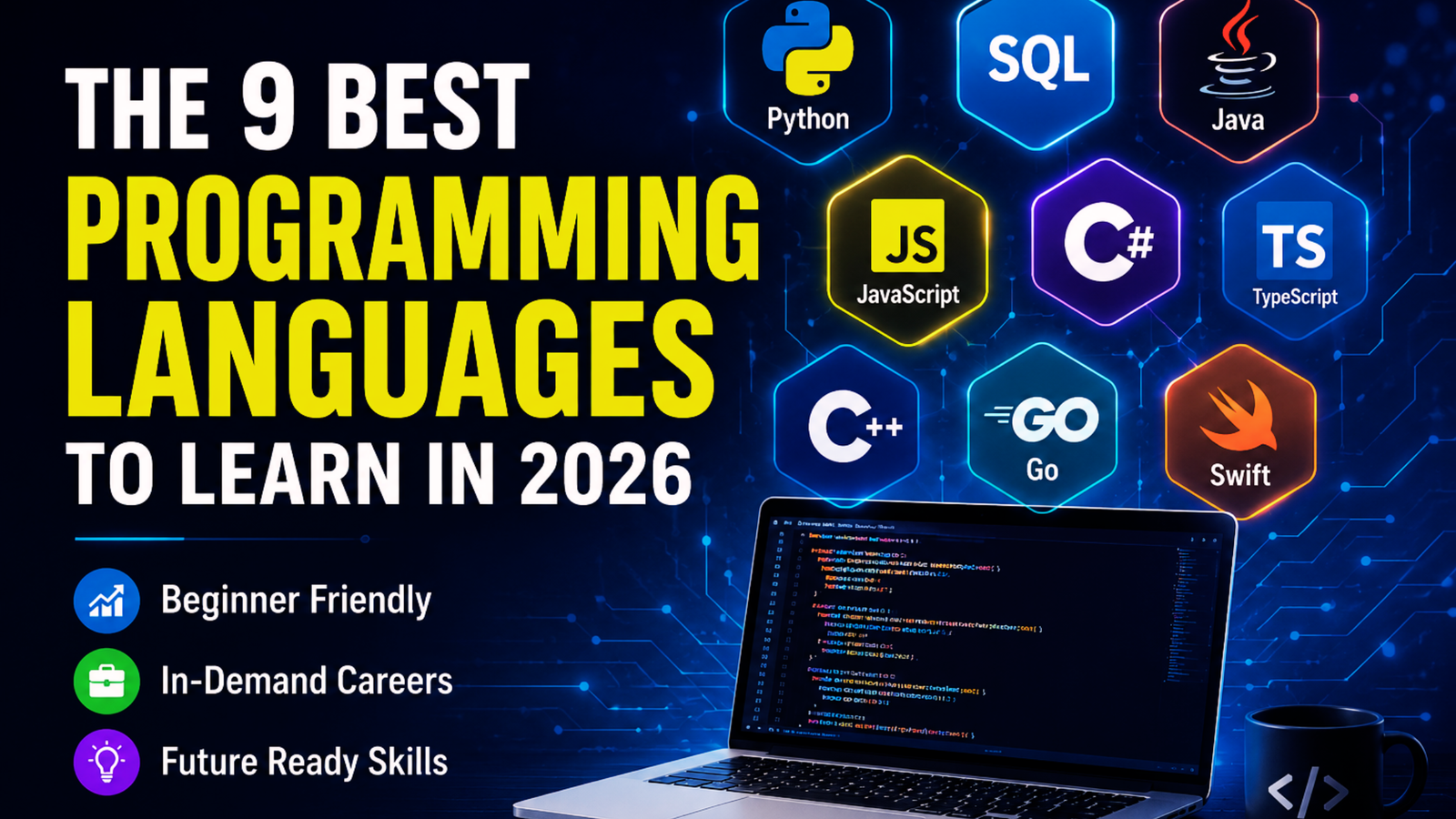
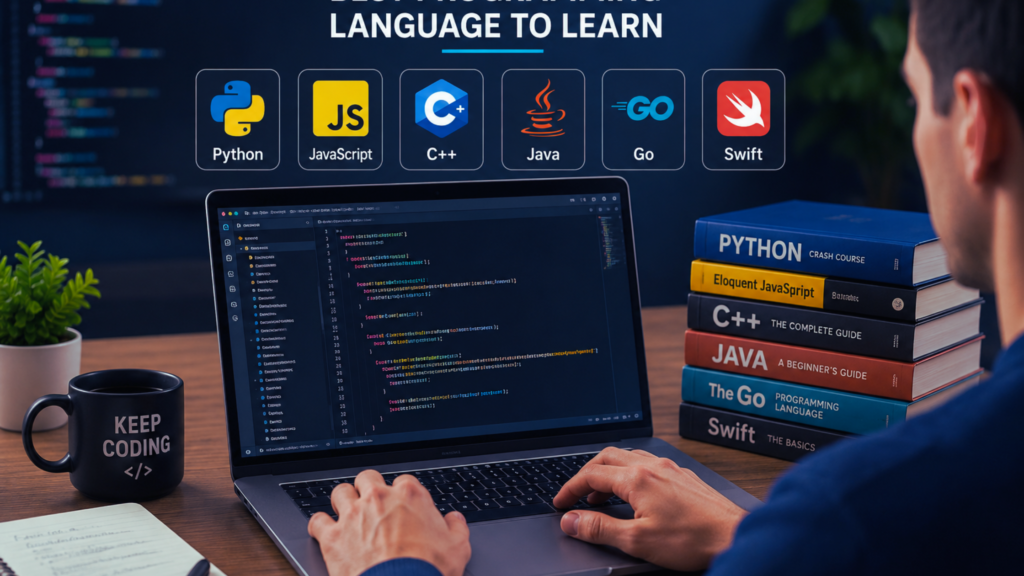
For this guide, we have selected nine programming languages that are worth considering in 2026:
- Python – A strong choice for beginners, AI, automation, and data science.
- SQL – An important skill for working with databases and data.
- Java – Widely used for enterprise software and backend development.
- JavaScript – A key language for websites and web applications.
- C# – Useful for software development and game development with Unity.
- TypeScript – A popular choice for larger and more structured web applications.
- C++ – Well suited to games, systems, and performance-focused software.
- Go – Useful for backend services, cloud infrastructure, and scalable applications.
- Swift – Designed for developing applications across Apple’s platforms.
The sections below take a closer look at each language, including what it can do, why you might want to learn it, and who it is best suited for.
1. Python
Python is one of the most popular choices for people who are starting their programming journey. Its syntax is clean and easy to read, which means beginners can focus on understanding how programming works instead of getting stuck on complicated code.
But Python is not only for beginners. It is used across many areas of technology, including artificial intelligence, machine learning, data science, automation, web development, and scripting. That wide range of uses makes it a practical language to learn if you are still figuring out which area of tech interests you most.
Why Learn Python?
One of Python’s biggest advantages is its simple syntax. You can often understand what a Python program is doing without spending a lot of time decoding the code.
Python also has a huge collection of libraries and tools. These allow developers to add features without building everything from scratch.
Another reason to learn Python is its use in AI and data-related fields. It is commonly used with tools and frameworks for machine learning, data analysis, and other modern technology projects.
Python is also useful for everyday automation. Developers can write scripts to handle repetitive tasks, process files, collect information, or perform other routine jobs.
Common Python Careers
Learning Python can open the door to several different career paths. Depending on your interests, you could work toward roles such as:
- Python developer
- Data analyst
- Data scientist
- AI or machine learning engineer
- Automation developer
- Backend developer
- DevOps engineer
You do not have to decide on one of these careers immediately. Python gives you the flexibility to explore different areas before choosing a specialization.
Difficulty Level
Beginner-friendly
Python is often considered one of the easiest programming languages for beginners to learn. Its readable syntax makes it a good starting point if you have never written code before.
That does not mean becoming an advanced Python developer is easy. You will still need regular practice and a good understanding of programming concepts. However, Python lets you get started without dealing with as much complicated syntax as some other languages.
2. SQL
SQL, or Structured Query Language, is used to work with information stored in databases. Whenever a website or application needs to save and retrieve data, SQL can often be part of the system behind it.
For example, an online store might use a database to keep track of products, customers, and orders. SQL allows developers and data professionals to find specific information, add new records, update existing data, or remove information when needed.
Unlike some programming languages, SQL has a more specific purpose. It is mainly focused on working with databases, which makes it a valuable skill for developers and anyone who works with data.
Why Learn SQL?
One of the biggest reasons to learn SQL is how widely databases are used. Businesses rely on stored data for everything from customer records and sales information to reports and analytics.
SQL is also relatively easy to get started with. Its commands are often straightforward to understand, making it a good additional skill for beginners who are learning how data works.
Another advantage is that SQL works with popular relational database systems. Once you understand the core concepts, you can apply your knowledge across different database technologies.
If you are interested in data analysis, backend development, or business intelligence, learning SQL can be especially useful.
Common SQL Careers
SQL is used across many technology and data-related roles, including:
- Data analyst
- Data scientist
- Business intelligence analyst
- Database administrator
- Backend developer
- Quality assurance engineer
You may not always see a job advertised simply as an “SQL developer.” Instead, SQL is often one of the skills expected as part of a broader role.
Difficulty Level
Beginner-friendly
SQL is generally easier to start learning than many general-purpose programming languages. The basic commands are relatively simple, although more advanced database queries can become challenging.
If you are new to programming or interested in working with data, SQL can be a useful language to add to your skill set.
3. Java
Java has been around for decades, but it is still an important language in software development. It is widely used for large applications, backend systems, enterprise software, and other projects where reliability matters.
One reason Java has remained popular is its versatility. Developers can use it to build different types of applications without being tied to a single platform or industry.
Java also follows object-oriented programming principles. This helps developers organize larger applications into manageable parts and makes it easier to work on complex software projects.
Why Learn Java?
Java has a mature ecosystem with a large collection of libraries, frameworks, and development tools. This means developers have plenty of resources available when building applications or solving problems.
It is also widely used in business and enterprise environments. Many large organizations depend on Java-based systems, so learning the language can be useful if you want to work in professional software development.
Another advantage is that Java teaches solid programming concepts. Understanding object-oriented programming, data structures, and application design through Java can make it easier to work with other languages later.
Common Java Careers
Java skills can be useful in several software development roles, including:
- Java developer
- Backend developer
- Software engineer
- Enterprise software developer
- Android developer
Java is especially worth considering if you are interested in building large-scale applications or working with backend systems.
Difficulty Level
Intermediate
Java is not usually considered the easiest language for a complete beginner. Its syntax and programming concepts can take some time to understand.
However, with consistent practice, beginners can learn Java successfully. Once you understand its fundamentals, you will have a strong foundation for working on more complex software projects.
4. JavaScript
If you are interested in building websites, JavaScript is one of the most useful languages you can learn. It helps developers make web pages more interactive and responsive instead of keeping them as simple, static pages.
JavaScript runs in web browsers and is behind many of the features people use on modern websites. Buttons, interactive forms, menus, animations, and other dynamic elements can all be created with JavaScript.
It has also grown beyond the browser. With tools such as Node.js, developers can use JavaScript for backend development as well. This makes it possible to use the language across different parts of a web application.
Why Learn JavaScript?
One of the biggest reasons to learn JavaScript is its importance in web development. It is supported by modern browsers and has a huge ecosystem of libraries, frameworks, and development tools.
JavaScript is also flexible. You can start by creating simple interactive webpages and gradually move toward larger web applications as your skills improve.
Another advantage is the size of its developer community. If you run into a problem while learning, there are plenty of tutorials, documentation, examples, and community discussions available online.
Common JavaScript Careers
JavaScript skills can be useful for several web development roles, including:
- Frontend developer
- Web developer
- Full-stack developer
- Web application developer
- Backend developer
If your goal is to build modern websites or web applications, JavaScript is a strong language to have in your toolkit.
Difficulty Level
Beginner to Intermediate
The basics of JavaScript are relatively accessible to beginners, especially if you already understand basic HTML and CSS. However, advanced concepts and large JavaScript applications can take considerably more time to master.
Starting with small projects and gradually increasing their complexity is a good way to build confidence with the language.
5. C#
C# (pronounced “C Sharp”) is a programming language developed by Microsoft. It is closely connected with the .NET platform and is used to build different types of software, from web applications and backend services to desktop programs.
C# is also well known in game development because it is commonly used with Unity. This makes it an interesting choice if you want to learn programming while working toward a career in game development.
The language has a structured syntax and supports object-oriented programming, which helps developers organize larger projects and keep their code manageable.
Why Learn C#?
One reason to learn C# is its flexibility. You can use it to create applications, websites, backend services, and games without needing to learn a completely different language for every project.
C# is also a strong choice if you want to work with Microsoft’s technology ecosystem. The language works closely with .NET and other Microsoft development tools.
Another advantage is its use in Unity. If you have an interest in creating games, learning C# gives you a useful foundation for building gameplay mechanics and interactive experiences.
Common C# Careers
C# skills can be useful for roles such as:
- C# developer
- .NET developer
- Backend developer
- Software developer
- Game developer
- AR/VR developer
The right career path depends on which part of the C# ecosystem you choose to focus on.
Difficulty Level
Intermediate
C# is more structured than some beginner-focused languages, so it may take a little time to become comfortable with its syntax and concepts.
However, beginners can learn it successfully with regular practice. If your goal is game development, software development, or working with .NET, the learning effort can be well worth it.
6. TypeScript
TypeScript is a programming language built on top of JavaScript. It includes all the features of JavaScript while adding extra tools that help developers write more organized and reliable code.
As web applications become larger and more complex, managing code can become challenging. TypeScript helps solve this by introducing static typing, which can catch certain errors before the code runs. This can make development smoother and reduce mistakes in larger projects.
Many modern web applications use TypeScript because it works well with popular frameworks and development tools. If you already know JavaScript, learning TypeScript is often a natural next step.
Why Learn TypeScript?
One of the biggest reasons to learn TypeScript is that it helps developers build larger applications with better structure and maintainability.
TypeScript also improves code readability. Clear definitions for variables, functions, and data types can make projects easier to understand, especially when multiple developers are working together.
Another advantage is its growing popularity in modern web development. Many companies use TypeScript in frontend and full-stack projects because it adds extra reliability while keeping the flexibility of JavaScript.
Common TypeScript Careers
TypeScript skills can be useful for several roles, including:
- Frontend developer
- Full-stack developer
- Web application developer
- Software engineer
- JavaScript developer
Because TypeScript is closely related to JavaScript, it is often used in careers focused on web technologies.
Difficulty Level
Intermediate
TypeScript is easier to learn if you already understand JavaScript basics. The additional concepts, such as static typing, may take some practice, but they can make writing and maintaining larger applications much easier in the long run.
7. C++
C++ is a powerful programming language that has been used for decades to build software where performance really matters. It gives developers more control over how a program uses computer resources, which makes it useful for demanding applications.
You will often find C++ in areas such as game development, system software, embedded systems, and other performance-focused projects. It is also used in situations where speed and efficient resource management are important.
C++ can be challenging when you are just starting out. It has more complex concepts than beginner-friendly languages such as Python, but learning it can give you a deeper understanding of how programs work.
Why Learn C++?
One of the main reasons to learn C++ is performance. The language allows developers to write highly optimized software and have greater control over memory and system resources.
C++ is also a useful choice for people interested in game development. Many game engines and performance-heavy applications rely on C++ for their core systems.
Another benefit is that C++ teaches you important programming concepts. Understanding memory management, data structures, and how software interacts with hardware can strengthen your overall programming knowledge.
Common C++ Careers
C++ skills can be useful in several technical careers, including:
- C++ developer
- Software engineer
- Game developer
- Systems programmer
- Embedded systems developer
- Performance-focused software developer
C++ can be particularly valuable if you want to work on software where speed, efficiency, and resource management are important.
Difficulty Level
Advanced
C++ is generally more difficult to learn than Python or JavaScript. Concepts such as pointers, memory management, and object-oriented programming can take time to understand.
However, beginners should not be discouraged. With patience and regular practice, C++ can be learned successfully. Once you become comfortable with its fundamentals, you will have a stronger understanding of how software works at a deeper level.
8. Go
Go, also called Golang, is a programming language designed with simplicity, speed, and efficient software development in mind. It was created by Google and is especially useful for building backend services, cloud applications, networking tools, and other systems that need to handle a lot of work reliably.
One of Go’s strengths is its straightforward syntax. It does not have as many complicated features as some older languages, which can make the code easier to read and maintain. It also includes built-in support for concurrency, allowing developers to handle multiple tasks efficiently.
Go has become a popular choice for cloud and infrastructure projects. It is used in many tools and services where performance, scalability, and reliability are important.
Why Learn Go?
Go is a good option if you want to work with backend or cloud-based software. Its simple design makes it easier to write and maintain code without adding unnecessary complexity.
Another reason to learn Go is its performance. It is a compiled language, so programs can run efficiently while still being relatively simple to develop.
Go is also useful for learning about concurrent programming. Its built-in approach to handling multiple tasks makes it suitable for applications that need to process many operations at the same time.
Common Go Careers
Go skills can be useful for roles such as:
- Go developer
- Backend developer
- Cloud engineer
- DevOps engineer
- Software engineer
- Infrastructure developer
If you are interested in cloud computing, backend systems, or scalable applications, Go can be a valuable language to add to your skills.
Difficulty Level
Intermediate
Go is relatively straightforward compared with some more complex programming languages. However, beginners may still need time to understand concepts such as concurrency, interfaces, and backend development.
If you already understand basic programming concepts, Go can be easier to pick up. Practicing regularly and working on small projects can help you build confidence and get comfortable with the language.
9. Swift
Swift is a programming language developed by Apple for building applications across its platforms. It is mainly associated with iOS and macOS development, making it an important language for anyone interested in creating apps for Apple devices.
Swift was designed to be modern, fast, and easier to work with than some older languages. It also includes features that help developers catch certain programming mistakes early, which can make application development safer and more reliable.
If you have an idea for an iPhone, iPad, or Mac application, learning Swift can give you the tools to turn that idea into a working app.
Why Learn Swift?
The biggest reason to learn Swift is its connection to Apple’s ecosystem. Developers use it to create applications for iPhone, iPad, Mac, Apple Watch, and other Apple platforms.
Swift is also designed with readability in mind. Its syntax is relatively clean, which can make it easier to understand as you build your programming skills.
Another advantage is that Swift works closely with Apple’s development tools and frameworks. This gives developers the tools they need to create modern apps and take advantage of Apple’s platform features.
Common Swift Careers
Swift skills can be useful for careers such as:
- iOS developer
- macOS developer
- Mobile app developer
- Apple platform developer
- Software engineer
If your goal is to build apps specifically for Apple devices, Swift is one of the most relevant languages to learn.
Difficulty Level
Intermediate
Swift is reasonably approachable, especially if you already understand basic programming concepts. However, becoming comfortable with app development requires more than learning the language itself.
You will also need to learn Apple’s development tools, frameworks, and app development practices. With regular practice, you can gradually move from simple projects to complete mobile applications
Which Programming Language Is Best for Beginners?
If you are completely new to coding, Python is one of the best programming languages to learn as a beginner. Its syntax is relatively simple, so you can focus on understanding programming concepts without getting overwhelmed by complicated code.
However, Python is not the only option. Your interests should also guide your decision.
If you want to build websites, JavaScript is a strong starting point. If you are interested in databases and data, SQL is an important skill to learn. For game development, C# can be a good choice, while Swift makes more sense if you want to build apps for Apple devices.
The best choice is the language that matches what you want to accomplish.
Which Programming Language Should You Learn First?
Start with the language that connects most closely to your goal.
For general programming and a beginner-friendly introduction, Python is a practical choice. You can use it for small scripts and gradually move into areas such as AI, automation, data science, or web development.
If web development is your main goal, start with JavaScript. You can learn HTML and CSS alongside it and then move toward frontend or full-stack development.
You do not need to learn several languages at once. Pick one, learn its fundamentals, and use it to build small projects. Once you become comfortable with programming concepts, learning another language becomes much easier.
How Long Does It Take to Learn Programming?
The time it takes to learn programming varies from person to person.
Your learning speed depends on how often you practice, how much time you have available, and what you want to build. Someone practicing every day will usually make progress faster than someone who only codes occasionally.
You can learn basic concepts such as variables, loops, conditions, and functions within a relatively short period. Getting comfortable enough to build useful applications takes time and consistent practice.
Try not to focus too much on a specific deadline. Regular practice is more important.
Even 30 minutes of coding each day can help you build a useful habit. As you improve, you can gradually spend more time working on projects and solving real problems.
Should You Learn More Than One Language?
You can, but there is no need to start with multiple languages.
When you are new to programming, switching between several languages can make things more confusing. Each language has different syntax and features, even though many programming concepts are shared.
It is usually better to become comfortable with one language first. Learn how variables, functions, loops, conditions, data structures, and other basic concepts work.
After that, learning a second language becomes much easier. For example, someone who understands JavaScript can move to TypeScript more comfortably because the two are closely connected.
The goal is not to collect programming languages. The goal is to develop skills that you can actually use.
Final Thoughts
Choosing the best programming language to learn does not have to be complicated. Start by thinking about what you want to build and what type of technology interests you.
Python is a strong option for beginners and can lead to areas such as AI, automation, and data science. JavaScript is a natural choice for web development, while SQL is valuable for working with databases and data. Java, C#, C++, Go, and Swift each have their own strengths and career opportunities.
You do not need to master everything at once. Choose one language, learn the basics, and start building small projects.
The more you practice, the more comfortable programming will become. And once you have a solid foundation, exploring another language will feel much easier.
Also read: How to Install Software from an ISO File
About the Author