Technology can make life easier, but it can also create some very specific frustrations.
Your Wi-Fi stops working when you’re in the middle of something important. Your phone reaches 1% battery when you’re nowhere near a charger. A program crashes without warning. Then there’s the special kind of frustration that comes from finding a coding bug after hours of searching and discovering that one tiny mistake caused it.
That’s why technology memes are so relatable.
Some are about everyday problems that almost anyone can understand. Others are aimed at programmers, IT workers, and people who spend most of their day around computers.
Here are some common types of tech humor and the real situations behind them.
Funny Technology Memes
You don’t have to work in tech to understand a good technology meme.
Many are based on ordinary problems people run into while using computers, phones, and the internet.
When your computer suddenly stops working
A computer can work normally all day and then fail when you need it most.
Sometimes the problem is complicated. Other times, restarting the computer fixes it.
A restart closes running programs and starts the operating system again. It can clear some temporary system errors, although it won’t fix every problem. Microsoft also recommends restarting as a basic troubleshooting step for some Windows issues.
That’s where the classic IT joke comes from: restart the computer and see what happens.
When the Wi-Fi disappears
You’re watching something, joining a meeting, downloading a file, or doing some work.
Then the internet stops.
You check your phone. You check the router. You wait a few seconds and try again.
Nothing.
Wi-Fi problems make easy meme material because the situation needs almost no explanation. Anyone who regularly uses the internet knows the frustration.
When your storage is full
You try to download a file and get a message saying there’s not enough storage.
Now you have to decide what to delete.
Maybe it’s hundreds of photos you don’t want to lose. Maybe it’s old videos, unused apps, or downloads you forgot about months ago.
Running out of storage can happen gradually. You may not think about it until your device suddenly refuses to save something.
When an update appears at the worst time
Software updates can add features, fix bugs, or address security problems, depending on the update. Microsoft’s Windows guidance also notes that updates can include fixes and performance improvements.
The timing can still be annoying.
Imagine opening your laptop right before a meeting and getting an update notification. Or launching a game only to find that it needs to download an update first.
The joke isn’t necessarily that updates are bad. It’s that they seem to appear when you have somewhere to be.
IT Support Memes
IT support has given technology humor plenty of material.
The same types of problems come up again and again, while the person asking for help doesn’t always describe the problem clearly.
“Have you tried turning it off and on?”
This is one of the most familiar IT jokes.
Restarting really can solve some temporary software problems. It closes running applications and starts the operating system again.
But good troubleshooting doesn’t end there.
If restarting doesn’t help, you still need to find out what changed, when the problem started, whether other users have the same issue, and what error messages appear.
The meme turns one basic troubleshooting step into the answer to every computer problem.
When you’re the family IT person
You don’t need an IT job to become the person everyone calls when technology goes wrong.
Someone buys a new phone.
Someone can’t connect the TV to Wi-Fi.
The printer won’t print.
Someone needs help with an account.
If you’ve fixed these problems before, you may become the family’s unofficial tech support.
The joke gets even better when people assume you’ll know how to fix something simply because you’re comfortable with computers.
“My computer doesn’t work”
That’s not much information for someone trying to diagnose a problem.
Does it turn on?
Is the screen blank?
Is the internet down?
Does one program fail?
Did anything change before the problem started?
A technician needs details like these to narrow down the cause.
That’s why the situation makes a good meme. The person asking for help thinks they’ve explained the problem, while the person helping knows the investigation has barely started.
The printer problem
Printers have earned their own place in technology humor.
A printer can show an error, get stuck with a job in its queue, run out of paper, or have a connection problem.
For someone who rarely deals with printers, figuring out what went wrong can become a frustrating task.
For an IT worker, it may be another familiar support request.
Programming and Coding Memes
Programming memes are more specific than general technology jokes.
Many make sense immediately to developers but may leave someone new to coding wondering what the joke means.
“It works on my machine”
A developer runs a program and everything works.
Someone else runs it and gets an error.
The two computers may have different operating systems, software versions, dependencies, settings, or environment variables.
So, saying “it works on my machine” doesn’t explain why the code fails elsewhere. It only tells you that the problem isn’t happening in that particular environment.
That’s why developers recognize the joke.
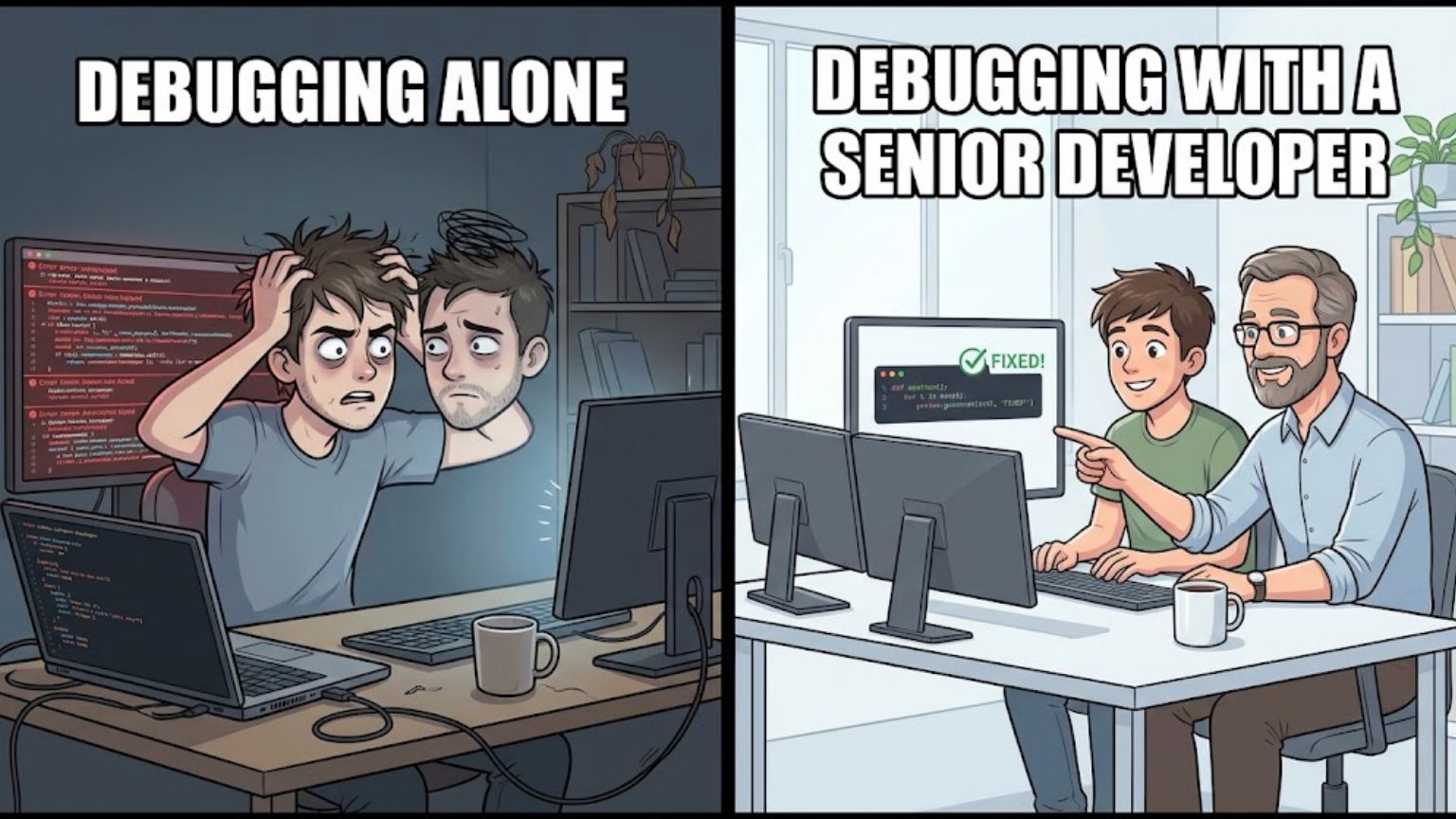
When you finally find the bug
Debugging can take a long time.
You read the code. You test different possibilities. You check the error message. You inspect values and try to narrow down the problem.
Eventually, you find it.
And it’s tiny.
Maybe you misspelled a variable. Maybe one character was missing. Maybe you made a simple assumption that turned out to be wrong.
The frustration comes from spending so much time looking for such a small mistake.
When fixing one bug creates another
Software can have many parts that depend on one another.
You change something to fix a problem, then discover that the change affects another part of the program.
That doesn’t mean every bug fix creates another bug. Testing and careful development can help catch problems before they reach users.
Still, developers know how frustrating it can be when solving one problem leads to an unexpected second problem.
Looking at your old code
A beginner may think their code looks fine when they first write it.
Months later, they may look at the same code and immediately see things they would do differently.
That’s normal as you learn.
With more experience, you understand better ways to structure code, name variables, handle errors, and solve problems.
The meme turns that learning process into a joke: your old code suddenly looks like it was written by someone you don’t remember.
The Friday deployment joke
Developers often joke about making changes late in the week because nobody wants a production problem to ruin their weekend.
Real development teams can use testing, code reviews, monitoring, and rollback procedures to reduce the risk of problems after a release.
The meme exaggerates the fear of seeing an unexpected error late on Friday afternoon.
AI and Modern Technology Memes
AI has become another subject for technology humor.
Many of these jokes focus on chatbots, generated code, and the difference between what someone asked for and what an AI tool produced.
When AI gives you a strange answer
AI tools can be useful, but their answers still need checking.
An AI system may misunderstand a question or provide information that isn’t correct. Sometimes the answer can sound confident even when it needs verification.
That’s why AI-related memes often show someone asking a simple question and receiving a strange answer.
There’s a useful lesson behind the joke for anyone learning technology:
Don’t assume an AI-generated answer is correct just because it sounds convincing.
For important information, check the answer against reliable sources.
Using AI for everything
AI tools can help with writing, coding, brainstorming, research, and other tasks.
That has also created a new type of joke: asking AI to handle something that would take a person only a few seconds.
The humor comes from treating a useful tool as if it needs to make every tiny decision.
AI can save time, but knowing when to use it is just as useful as knowing how to use it.
AI-generated code
AI coding tools can produce code, but generated code still needs to be understood and tested.
A beginner may be tempted to copy a snippet, see that it looks right, and move on.
That can cause problems if the code contains an error or doesn’t fit the rest of the project.
For someone learning programming, understanding the code is more useful than simply getting a working snippet.
That’s one reason AI coding jokes have become easy for developers to recognize.
Smartphone and Internet Memes
Technology humor isn’t limited to computers.
Phones and internet services provide plenty of material too.
When your phone reaches 1%
The battery indicator says 1%.
You immediately start looking for a charger.
The situation gets worse if you’re outside, travelling, or expecting an important call.
The funny part is how quickly that tiny percentage becomes the most important number on your screen.
When the internet stops working
A broken internet connection can interrupt streaming, gaming, video calls, remote work, online classes, or a simple search.
You restart the router.
You check another device.
You wait.
Then you check again.
That familiar routine is enough to become a relatable technology meme.
When autocorrect changes your message
You type a sentence.
Your phone changes one word.
You send it without noticing.
Then you read the message and realize your phone changed what you meant.
Autocorrect is meant to make typing easier, but it doesn’t always understand the context. That gap between what you intended to write and what appeared on screen makes an easy joke.
Forgetting your password again
Many people have several online accounts, each with its own password.
Then a website asks for a password you haven’t used in months.
You try one.
Wrong.
You try another.
Wrong again.
Soon you’re staring at the password-reset screen.
Using unique passwords and a reputable password manager can make managing multiple accounts easier and reduce the temptation to reuse passwords.
Workplace Technology Memes
Technology problems don’t stop when you get to work.
Meetings and daily tasks can depend on computers, internet connections, microphones, cameras, and software.
“Can you hear me?”
Someone joins a video meeting.
Their microphone doesn’t work.
They talk for several seconds before realizing they’re muted.
Someone else says, “You’re on mute.”
It has become a familiar video-meeting joke because a small audio setting can interrupt an otherwise simple conversation.
When screen sharing goes wrong
You intend to share one window.
Instead, you select the wrong one.
Or the presentation refuses to appear.
Or nobody can see the screen.
Screen sharing is simple when everything works. When it doesn’t, a small technical problem can suddenly take over the meeting.
The emergency IT request
Some technology problems become urgent because they happen just before something important.
A presentation won’t open ten minutes before the meeting.
A laptop won’t connect to a projector.
An application needs an update right before a presentation.
The person may have known about the problem earlier, but now it needs fixing immediately.
That’s the situation behind many workplace IT memes.
See Also: Best Programming Language to Learn in 2026: 9 Top Choices
Why Technology Memes Feel So Familiar
Technology memes often start with situations people recognize from everyday life.
A dead phone battery needs little explanation. Neither does a slow laptop, forgotten password, broken Wi-Fi connection, or computer that suddenly refuses to cooperate.
Tech workers have another layer of experiences to joke about. Developers deal with debugging and confusing code. IT staff deal with support requests. People who work with systems and networks have their own technical problems.
That gives tech humor a wide range.
Some jokes are understandable to almost everyone. Others are aimed at people who spend their working day with code, networks, hardware, or software.
The more specific the situation, the more likely the right audience will recognize it.
What Makes a Good Technology Meme?
A technology meme doesn’t need a complicated joke.
The strongest ones usually have a situation people recognize quickly and a punchline that fits it.
It’s easy to understand
The reader shouldn’t need a long explanation before getting the joke.
It describes a familiar problem
A slow computer or dead phone battery is easier to relate to than an obscure technical problem.
The punchline is clear
The setup should lead naturally to the joke. If the reader has to study the image to understand what is happening, the meme may lose its impact.
It matches its audience
A joke about debugging may work perfectly for developers but make little sense to someone who has never written code.
That’s fine. Not every technology meme needs to appeal to everyone.
It has a real situation behind it
The humor is stronger when the reader can say, “I’ve had this happen.”
That might be something as simple as losing Wi-Fi during a meeting or finding a bug after hours of debugging.
The Best Technology Memes Come From Real Problems
Technology gives us plenty of reasons to laugh.
Sometimes the problem is small, like a phone battery reaching 1%. Sometimes it’s more frustrating, such as a program failing for no obvious reason.
For tech learners, these jokes can also highlight something useful. Computers and software don’t always behave the way we expect, and troubleshooting often starts with simple questions and careful testing.
You don’t need to understand every programming joke or work in IT to enjoy technology memes. Some are about everyday problems that almost every computer, smartphone, or internet user knows.
The simplest tech jokes often work best because the situation feels real, the punchline is easy to understand, and you’ve probably experienced it yourself.
Conclusion
Technology memes turn everyday problems into short, recognizable jokes. Some focus on Wi-Fi, low battery, passwords, or software problems. Others are aimed at programmers and IT workers who deal with debugging, support requests, and technical issues every day.
For tech learners, a good meme can also give a familiar context to an unfamiliar idea. Research on programming memes has found evidence that students can reason about computing concepts through memes, even without a lesson explaining the meme first.
A meme shouldn’t replace proper learning, but it can make a technical idea easier to discuss or remember.
Frequently Asked Questions
What is a technology meme?
A technology meme is a humorous image, video, or piece of text about technology-related situations. It can focus on computers, programming, IT support, smartphones, AI, software, or internet use.
Why are technology memes so popular?
They turn familiar experiences into short jokes. A slow computer, broken Wi-Fi connection, difficult bug, or confusing support request can be understood quickly by people who have experienced the same thing.
Are technology memes only for programmers?
No. Some tech memes are aimed at developers or IT workers, but many cover everyday problems that anyone using a phone, computer, or internet connection can understand.
What are some common technology meme topics?
Common subjects include:
- Computer problems
- Wi-Fi and internet issues
- IT support
- Programming and debugging
- Software updates
- Passwords
- Smartphones
- AI tools
- Workplace technology
Can technology memes help with learning?
They can sometimes help learners connect a technical idea with a familiar situation. A study of programming memes found that students were able to reason about computing concepts through memes, and the researchers found indications of educational value.
A meme shouldn’t replace proper learning, but it can give learners another way to think about a technical idea.
Can I use any technology meme image on my website?
No. Finding an image online doesn’t automatically give you permission to republish it.
Before publishing a meme created by someone else, check its copyright status and the terms that apply to its use. If you don’t have the necessary rights or permission, don’t assume that credit alone makes republication legal.
For a safer approach, use memes you created yourself, images with a suitable license, or material you have permission to publish.
About the Author